
Table of Contents
- How Museum Merchandise Earns Its Authentic Status
- Official Merchandise vs. Souvenirs: The Core Difference
- Why Museum Commissioning Changes Everything
- Museum Gift Shop Quality Standards You Can Verify
- Digital Authentication Markers: The New Standard
- The 'Museum-Grade' Standard Explained
- Distinguishing Souvenirs From Heritage Objects
- Unique Gifts for Vintage Vegas Fans: What to Look For
- Conclusion: Shop With Confidence and Purpose
- Frequently Asked Questions
Last Updated: September 27, 2026
How Museum Merchandise Earns Its Authentic Status
Museum merchandise is authentic when the institution that owns the collection commissions, approves, and documents it. That chain of authorization, not a logo slapped on a tote bag, separates real museum merchandise from the souvenir rack down the street. At Liberace Museum Store, every item traces back to the Liberace Museum Collection and the Foundation that cares for it. This guide shows you how to tell the difference in about five minutes of careful looking.

The gap is wider than most shoppers expect. A licensed product carries a paper trail: who approved the design, which photograph or costume it came from, and where the money goes. A souvenir carries none of that. Below, we'll walk through the exact checks curators and collectors use, and the one question that settles most debates.
Official Merchandise vs. Souvenirs: The Core Difference
The core difference is authorization. Official merchandise is a product the museum itself commissions or licenses, tied to a specific object in its collection and sold to fund its work. A souvenir is any item made to look like it belongs to a place, with no institutional approval behind it.
That distinction matters for three reasons:
- Provenance. Official goods name the source object, like a costume or a photograph.
- Money flow. Museum sales support the collection and its programs.
- Accountability. The institution stands behind what it sells.
A souvenir can be charming. It just isn't evidence of anything.
Why Museum Commissioning Changes Everything
Commissioning is the step most shoppers never see, and it's the step that creates authenticity. When a museum commissions a product, staff select the source object, approve the artwork, and set the quality bar before anything is made.
This is where material authenticity gets decided.
Museum Gift Shop Quality Standards You Can Verify
You can verify museum gift shop quality standards without any special tools. Start with the object itself, then check the paperwork, then check the seller. The order matters, because a convincing print on a cheap blank will pass a visual test and fail a paperwork test.
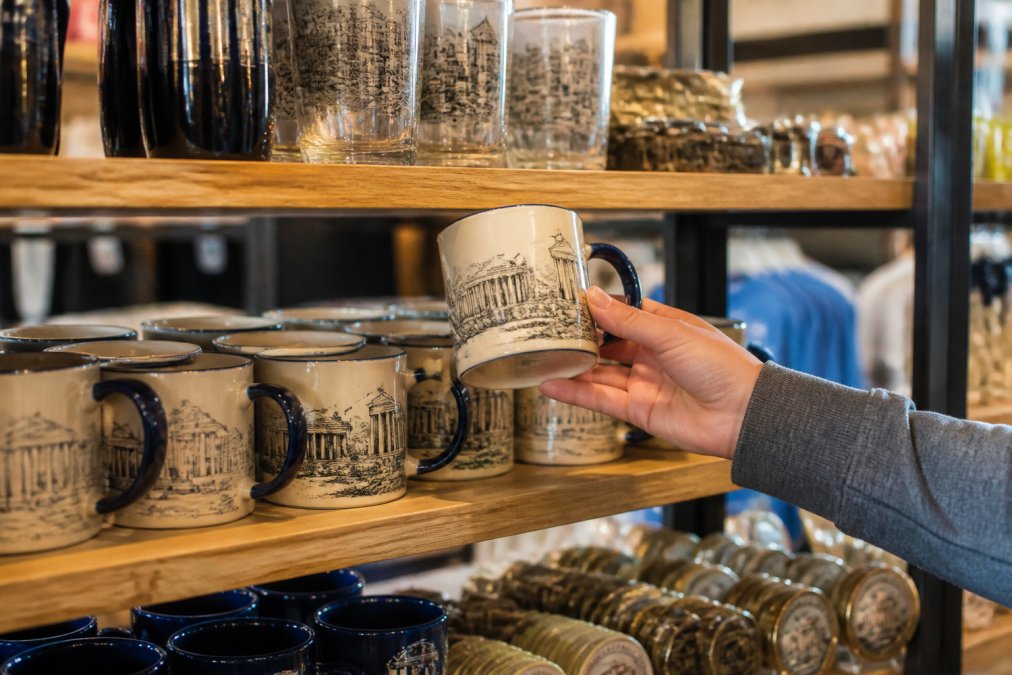
Here's what to look for, in order:
- Print and material quality. Sharp image edges, no blur, no color banding. On ceramics, check that the print wraps cleanly and the glaze is even.
- Source credit. Official items usually name the photograph, costume, or collection they come from. A credit line that reads "Photo: [Foundation name], [collection name]" is doing real work; a credit line that reads "inspired by" is not.
- Copyright line. A Foundation or museum copyright notice is a strong signal of authorized production. Look for the year and the rights holder, not just a symbol.
- Seller identity. Buy from the institution's own store, not a marketplace reseller. Resellers can carry genuine goods, but they rarely carry the documentation that proves it.
The Counterfeit Detection Checklist
Hard-to-fake signals (weight these heavily):
- The listing names the exact source object, a specific costume, photograph, document, or accession number, not a general theme.
- A copyright or trademark line names a real rights holder, with a year.
- The same item appears on the institution's own store, at the same specs.
- The seller states where the proceeds go, and that statement matches the institution's published mission.
- Product specs are complete: material, dimensions, capacity.
Easy-to-fake signals (treat as supporting evidence only):
- A logo or wordmark. Anyone can print one.
- The phrase "official" or "authentic" in the title. This is a claim, not proof.
- A price that matches the official listing. Counterfeiters often price at parity to avoid suspicion.
- A glossy product photo. Good photography is cheap.
- A "limited edition" label with no stated run size.
How to read the results:
- Two or more hard-to-fake signals missing, walk away. You are probably looking at a replica or a knockoff.
- All hard-to-fake signals present, one or two easy-to-fake signals missing, you're likely fine; the missing items are usually just sloppy listing copy.
- Hard-to-fake signals present but the seller won't answer a direct question about the source object, treat that as a missing signal. Evasion is itself data.
One trade-off worth naming: strict verification takes time, and small museum stores sometimes have thin listings that look suspicious but aren't. When in doubt, buy directly from the institution's own store, you trade a little browsing convenience for a much shorter verification chain.
Digital Authentication Markers: The New Standard
Digital authentication markers are the newest layer in this fight, and most shoppers haven't heard of them yet. These are scannable codes, serial numbers, or registry entries that link a physical item to a record held by the institution. Think of them as a birth certificate for the object.
Liberace Military Costume Print Mug →
The 'Museum-Grade' Standard Explained
"Museum-grade" describes production that meets curatorial standards for materials, documentation, and approved reproduction of collection objects. It is not a legal term, and no agency certifies it. That's exactly why you should treat the phrase with suspicion unless the institution backs it up.
A true museum-grade item usually has:
- A documented source object in the collection
- Approval from curatorial staff
- A stated connection to the museum's mission
Distinguishing Souvenirs From Heritage Objects
A souvenir reminds you of a trip. A heritage object carries a documented link to a person, place, or collection. The line between them comes down to provenance and artistic integrity, but in practice, the line is blurrier than the table below suggests, and knowing where it blurs is what separates a confident buyer from a cautious one.
| Feature | Souvenir | Heritage Object |
|---|---|---|
| Source | Generic design | Named collection object |
| Approval | None | Museum or foundation |
| Documentation | Rarely | Copyright line, source credit |
| Proceeds | Private seller | Supports the institution |
| Production | Mass-produced | |
| Reproduction basis | Invented or approximated | Photographed or scanned from the object |
Where the Line Actually Blurs
Three cases trip up even careful shoppers:
- Licensed reproductions. A manufacturer pays a fee to use a museum's image, but the museum may not control materials or quality. The license is real; the provenance is thin. Ask whether the museum commissioned the product or merely licensed the image.
- Reissues of historic merchandise. A store may reprint a design that was sold decades ago. That's a heritage object if the original design is documented and the reissue is authorized; it's a souvenir if the design was reconstructed from memory.
- Artist-made goods sold on consignment. The maker may be genuine, but the museum's role may be limited to shelf space. Consignment is not the same as commissioning.
What 'Museum-Grade' Actually Means
"Museum-grade" is the phrase most likely to mislead a shopper, because it sounds like a certification and isn't one. In a conservation context, the term refers to materials and methods that meet archival standards, acid-free paper, pigment-based inks, stable plastics, controlled light exposure. In a retail context, it usually means nothing more than "we think this is nice."
A defensible museum-grade claim usually includes:
- A documented source object in the collection, identified by name or accession number.
- Approval from curatorial staff, not just the retail or marketing team.
- A stated connection to the museum's mission, so the buyer knows what the purchase supports.
The practical test: a heritage object can answer three questions without hesitation, what is it based on, who approved it, and where does the money go. A souvenir can usually answer none of them, and a licensed reproduction can answer the first but stumbles on the second.
Unique Gifts for Vintage Vegas Fans: What to Look For
Unique gifts for vintage Vegas fans should carry a real connection to the era, not just a neon font. The strongest options come from institutions that actually hold the history.
Conclusion: Shop With Confidence and Purpose
The hard part of buying memorabilia is trust. Anyone can print a logo, but only an institution can authorize a reproduction and stand behind it. Use the checklist above, ask where the design came from, and follow the money.
Frequently Asked Questions
What is the difference between a souvenir and authentic museum merchandise?
A souvenir is typically a mass-produced item sold for convenience, while authentic museum merchandise is commissioned or licensed by the museum itself. It often carries official seals, copyrighted imagery, and ties to specific collection pieces. For example, the Liberace Museum Store offers mugs featuring copyrighted photographs of actual Liberace costumes, like the Military Costume Print Mug, which directly supports the museum's collection and arts education.
Do museum gift shops sell real artifacts?
No, museum gift shops do not sell original artifacts. Instead, they offer reproductions, licensed merchandise, and derivative works approved by the museum. These items are often based on high-resolution photography or direct scans of collection pieces. Authentic museum merchandise means the museum authorized its creation, not that it is a historical artifact itself.
How do museums ensure the quality of their merchandise?
Museums follow strict museum gift shop quality standards, which include material authenticity, color accuracy, and durability testing. They work directly with manufacturers to approve every detail, from fabric weight to print resolution. Many items are produced in limited editions to maintain exclusivity. This process ensures that each piece reflects the museum's curatorial standards and artistic integrity.
Why does buying from a museum store support arts education?
Proceeds from museum store sales often fund educational programs, exhibitions, and collection care. When you buy authentic museum merchandise, you directly contribute to these efforts. For instance, the Liberace Museum Store supports the Liberace Foundation's commitment to arts education, so your purchase helps preserve cultural heritage and inspire future artists.