
Table of Contents
- Why Vintage Las Vegas Decor Still Commands Attention
- Mid-Century Modern Meets Desert Modernism: Building Your Color Palette
- Neon Aesthetic and Custom Signage for Retro Glamour
- How to Style a Vintage Bar Cart With Lounge Decor Flair
- Best Practices for Collecting Vintage Decor and Memorabilia
- Small-Space and Budget-Friendly Ways to Get the Look
- Conclusion: Styling a Space That Celebrates the Glitz and Glamour
- Frequently Asked Questions
Last Updated: September 20, 2026
Why Vintage Las Vegas Decor Still Commands Attention
Vintage Las Vegas home decor ideas work because they combine two things most interiors lack: a story and a wink. The city's golden era, from the 1950s through the 1970s, produced a design language of glitter, bold geometry, and unapologetic excess that never went out of style. At Liberace Museum Store, we offer a curated collection of apparel, accessories, and memorabilia inspired by the legendary glitz and glamour of Liberace.
Mid-Century Modern Meets Desert Modernism: Building Your Color Palette
The best vintage Las Vegas rooms start with color, not furniture. Mid-century modern and desert modernism share a palette of warm neutrals cut with saturated jewel tones, and that combination gives the look its glow. What most guides skip is the technical part: how much of each color to use, how to balance neon against neutrals, and which materials carry which tones.
A working palette for most rooms:
- Base: warm sand, terracotta, or soft cream for walls and large upholstery
- Jewel accents: emerald green, sapphire blue, ruby red
- Metallics: brass, gold, and polished chrome for hardware and trim
- Pops: hot pink or turquoise for one or two small pieces only
The 60-30-10 Rule, Translated for a Glam Room
Designers commonly use a 60-30-10 proportion: 60 percent dominant color, 30 percent secondary, 10 percent accent. For a vintage Las Vegas room, the 60 is your warm neutral, the 30 is one jewel tone, and the 10 is where neon pink, turquoise, or chrome lives. If your neon accent creeps past roughly a tenth of the visible surface area, the room reads as a theme rather than a design.
Balancing Neon Against Neutral Interiors
Neon colors are the hardest element to integrate because they are high-chroma and high-saturation. Give them a neutral field to sit against: a hot pink sign on a warm cream wall reads as glamour; the same sign on a saturated teal wall reads as noise. Keep at least one large neutral surface within sight of every neon piece.
Material Palettes That Carry the Color
Color and material are a single decision. The same emerald green reads differently on velvet, lacquer, and glass:
- Velvet absorbs light and deepens jewel tones, which suits upholstery and throw pillows.
- Lacquer reflects light and makes saturated colors pop, which suits cabinets and bar carts.
- Glass and mirrored surfaces multiply neon and metallic tones, which suits tabletops and trays.
- Brass and gold warm every color near them; chrome cools them.
Atomic Age Accents and High-Contrast Pairings
Atomic age design supplies the shapes: starbursts, boomerangs, tapered legs, and kidney curves. Pair those forms with high-contrast color and the room reads instantly as mid-century without feeling like a museum. The common mistake is overloading the palette, pick one jewel tone and let everything else support it.
Neon Aesthetic and Custom Signage for Retro Glamour
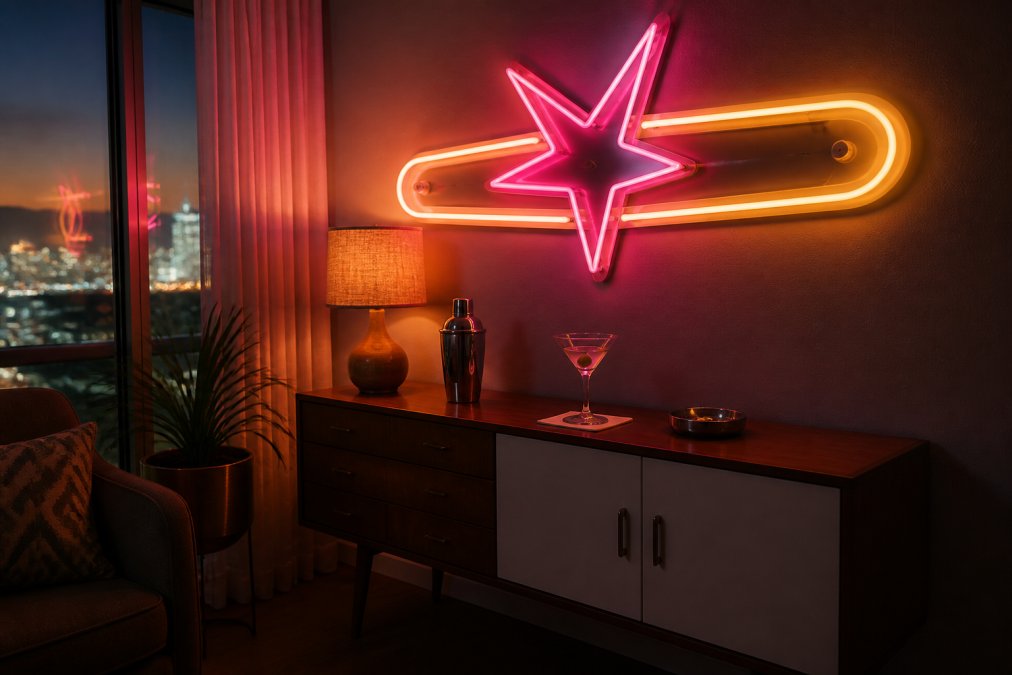
Neon is the fastest way to signal vintage Las Vegas, and it doesn't require a casino-sized budget. A small custom sign or reproduction piece above a console or bar delivers the neon aesthetic with real impact.
How to Style a Vintage Bar Cart With Lounge Decor Flair
A bar cart is the anchor piece of a vintage Las Vegas room, and styling one well comes down to layers: glassware, a metallic tray, one oversized accent, and mood lighting. Brass and glass two-tier carts are the classic choice, but a lacquered black or cream cart works against a bold wall. Keep the top tier for serving and the bottom for display.
Barware, Accent Pieces, and Mood Lighting
The barware sets the era: coupe glasses, lowball tumblers, and a weighted cocktail shaker read as mid-century, while crystal decanters add glitz without shouting. Add one accent piece that ties the cart to the room's story, a vintage-inspired throw pillow or framed nostalgic print gives the setup a narrative instead of just a drink station. Mood lighting finishes it: a small lamp with a colored bulb, or a dimmer on the neon sign above, changes the feel after dark.
Cart Element |
What to Choose |
Why It Works |
|---|---|---|
Cart frame |
Brass, glass, or lacquered black |
Reads mid-century instantly |
Barware |
Coupe glasses, shaker, decanter |
Matches the era's drinking culture |
Accent piece |
Pillow, print, or small sculpture |
Adds story, not just utility |
Lighting |
Colored bulb or dimmable neon |
Creates lounge atmosphere at night |
Best Practices for Collecting Vintage Decor and Memorabilia
Collecting vintage decor works best when you buy fewer, better pieces and verify authenticity before you spend. The difference between a genuine artifact and a themed knockoff shows up in materials, provenance, and how the piece ages. The real value is in where you source and how you authenticate.
Liberace Wardrobe Self-adhesive Door →
A few rules that save collectors money and disappointment:
- Buy the story, not just the object. Provenance, documentation, and origin matter more than the piece itself.
- Inspect materials. Genuine mid-century pieces use solid wood, real brass, and hand-finished glass. Repro pieces usually reveal themselves in plastic trim and printed surfaces.
- Start with one category. Collectible chips, barware, or signage. Spreading across categories makes a collection look scattered.
- Check the source. Museum-affiliated stores and documented collections carry accountability that flea market stalls don't.
Sustainable Vintage Sourcing: Where to Actually Look
The channels worth working, roughly in order of verification:
- Estate sales. The richest source for mid-century furniture and barware. Look in older neighborhoods where original owners kept pieces for decades. Arrive early on day one for selection, or late on the last day for discounts.
- Consignment and thrift shops. Inventory turns constantly, so a weekly visit beats a marathon trip. Ask staff whether they hold estate pieces back for a specific day.
- Museum-affiliated stores. These resell documented pieces tied to real collections, giving you provenance a flea market cannot.
- Online estate marketplaces and auction sites. Best for signage or barware, but read condition reports carefully and account for shipping on fragile glass and ceramics.
- Estate sale aggregator apps and local listings. Useful for planning a route across several sales in one morning.
Set a monthly budget, pick one category, and only buy when a piece beats what you already own. That discipline separates a collection from an accumulation.
How to Authenticate a Piece Before You Buy
Authentication is a checklist, not a gut feeling. Run through these in order:
- Flip it over. Look for manufacturer marks, model numbers, or country-of-origin stamps. Genuine mid-century pieces often carry a maker's mark; reproductions frequently have none or a modern printed label.
- Check the fasteners. Flat-head screws, dovetail joints, and solid wood indicate older construction. Phillips-head screws and particleboard point to a later or reproduction piece.
- Test the metal. Real brass is heavy and develops a patina; brass-plated or painted metal is lighter and flakes at the edges.
- Inspect the glass. Hand-finished glass has slight irregularities; molded or printed glass is uniform and often has a seam.
- Ask for the story. A seller with documentation, a photo, or a clear origin will share it. Vague answers are a signal.
Authentic Vintage vs. Reproduction Decor
Authentic vintage pieces carry history and hold value; reproduction decor gives you the look at a lower price and often better durability. Neither is wrong, but mixing them without knowing which is which is how collections lose credibility. A practical middle path: buy authentic for focal points, and use reproduction for high-wear items like pillows, curtains, and decals.
Small-Space and Budget-Friendly Ways to Get the Look
You don't need a den or game room to pull off vintage Las Vegas decor. Small-space application comes down to concentrating the look in one zone and using soft goods to carry the theme. The most effective budget moves:
- Start with textiles. A themed pillow, curtain, or shower curtain delivers the aesthetic for a fraction of the cost of furniture.
- Use decals instead of art. A self-adhesive decal adds a large-scale image without framing or wall damage.
- Shop sustainable vintage. Estate sales, consignment shops, and museum stores resell documented pieces rather than feeding new production.
- Pick one wall. A single styled wall reads as intentional. Themed clutter across an entire apartment reads as chaos.
Conclusion: Styling a Space That Celebrates the Glitz and Glamour
Building a vintage Las Vegas room is an exercise in restraint disguised as excess. The pieces that work hardest have a real story behind them, a documented artifact, a piece of heritage decor, or a decal made from an actual photograph.

Frequently Asked Questions
What are the defining characteristics of vintage Las Vegas interior design?
Vintage Las Vegas decor blends mid-century modern lines with high-contrast color palettes, neon-inspired lighting, and a generous dose of glitz and glamour. Look for atomic age shapes, brass and mirrored finishes, velvet upholstery, and statement pieces like a retro casino sign or a curated collection of nostalgic prints. The goal is visual impact that feels celebratory rather than museum-like, mixing authentic vintage finds with reproduction decor where the original is out of reach.
How do I style a vintage bar cart without it looking cluttered?
Start with a two-tier cart and assign each level a job. The top tier holds barware, a decanter, and two to four glasses. The bottom tier gets accent pieces: a small framed print, a vintage ashtray, or a folded bar towel. Keep the palette to two or three colors so the items read as a curated collection rather than a pile. Rotate pieces seasonally to keep the display fresh without buying more.
Where can I find authentic vintage memorabilia for my home?
Estate sales, collector forums, and museum-affiliated stores are your best bets for authentic vintage memorabilia. Museum stores often carry officially licensed reproductions made from archival photographs and artifacts, which gives you the look without the fragility of a 60-year-old original. When buying online, ask for provenance details and check whether the seller names the source collection or archive behind the design. The Liberace Museum Store often has unlisted artifacts and antiques for sale as well. Inquire at the online store to see what is available.
How do I balance kitschy vintage decor with a modern living space?
Anchor the room with neutral, modern furniture, then layer vintage pieces as focal points. One bold item, such as a neon sign or a patterned curtain made from an archival design, does more work than five small tchotchkes. Repeat one accent color across the room to tie the eras together. If a piece feels like too much, move it to a smaller space like a powder room or home bar where the retro energy can be the main event. The designer of the Liberace exhibits, as well as the venues where his collection is housed is the renowned taste maven Paulina Biggs Sparkuhl. Inquire with her as well through the Liberace Museum Store.